Research
We Asked 71 HR Pros to Spot the AI. On Voices, They Did No Better Than a Coin Flip.
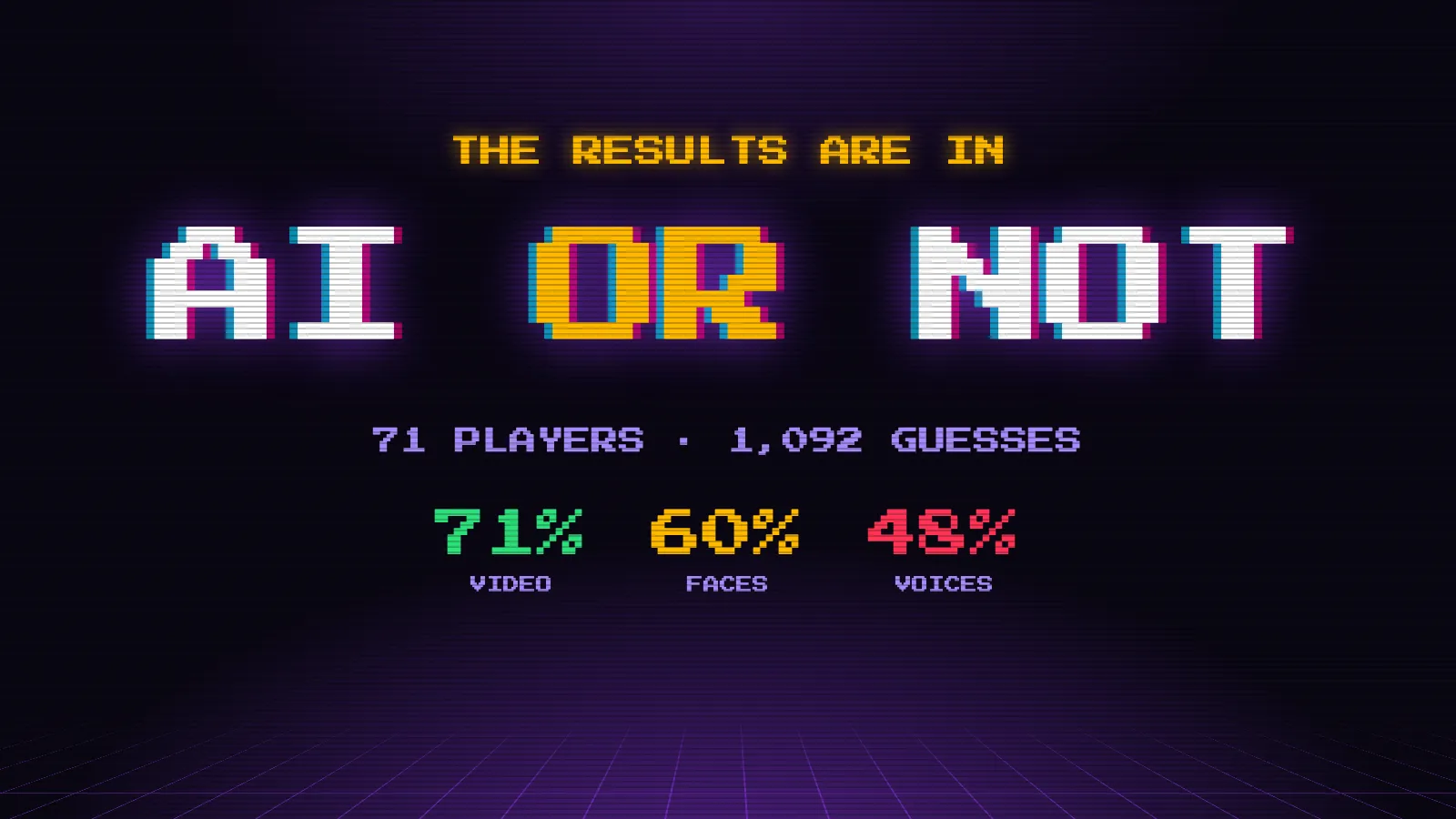
On 2 October we had a booth at Mannauðsdagurinn 2026, the annual HR Day held by Mannauður, the Icelandic association of HR professionals. At the booth we ran an arcade game called AI or Not. Each game had three rounds: four faces, five voice clips and five videos. Players had ten seconds per clip to decide whether it was real or AI-generated, and earned more points for fast answers and streaks of correct ones.
71 people played, making 1,092 guesses in total.
Results by round
Players were right 60% of the time overall, but the rounds differed a lot:
- Video was the easiest round, at 71% correct.
- Faces came next at 60%. Most of that came from recognising real faces. Players identified fewer than half of the AI faces.
- Voices came last at 48%, which is no better than guessing. Players did worse on real human voices than on AI ones.
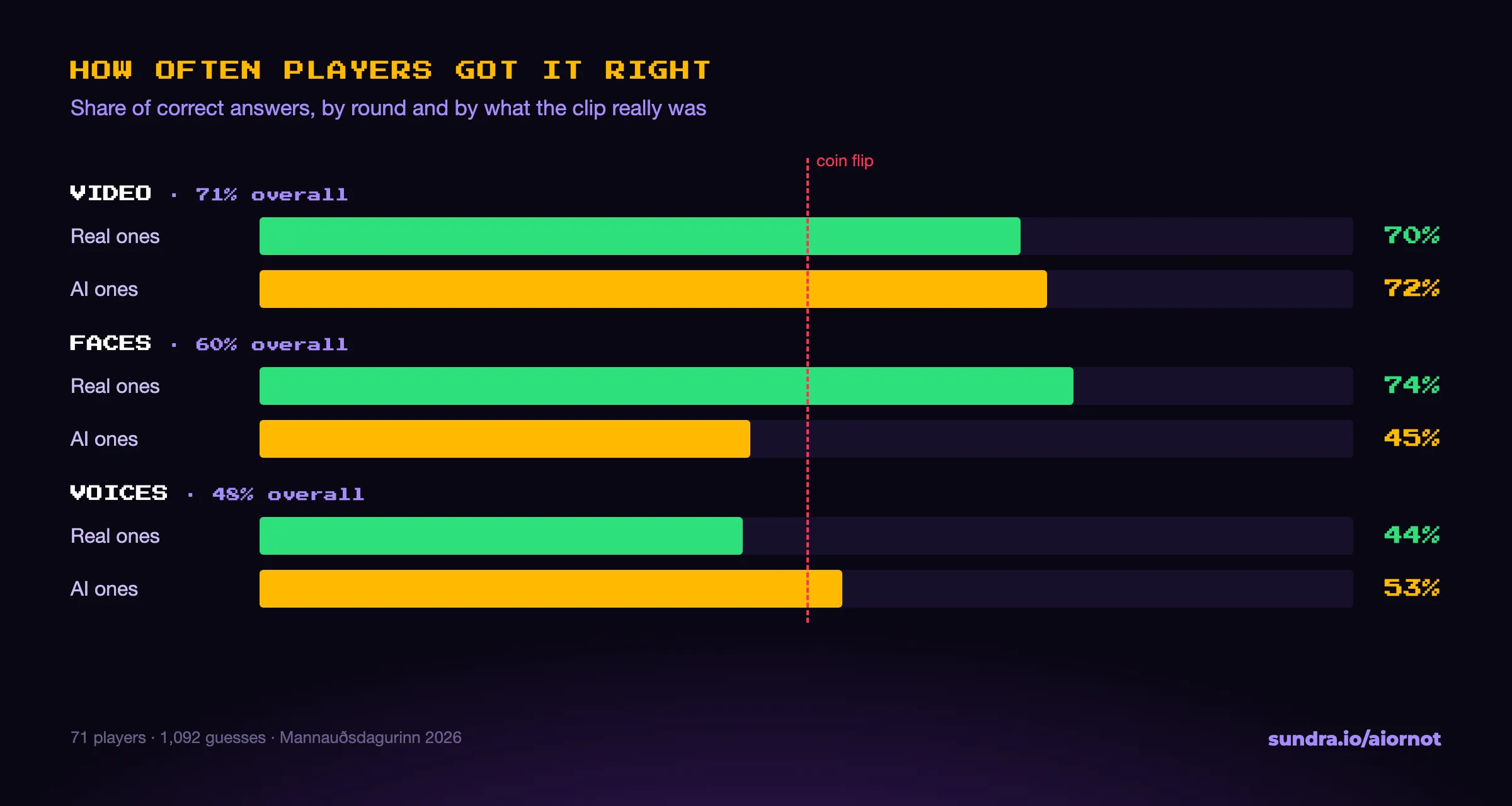
The overall figure for each round has a margin of error of about ±5 percentage points (95% confidence), so the gap between video and voices holds up. The real and AI figures within each round are less precise, at about ±7 points.
Voices: real narrators were mistaken for AI
Players identified 53% of the AI voices correctly but only 44% of the real recordings.
The real clips were volunteer readings of classic books from LibriVox, including Alice in Wonderland, Moby Dick, Sherlock Holmes and The Art of War. On the English recordings, players recognised the human reader 39% of the time. All seven players who heard one Alice in Wonderland reading got it wrong. Listen to it next to an AI voice reading the same book:
One likely explanation is that people expect AI voices to sound smooth and even, so a calm, clearly recorded human reader sounds artificial to them. The AI voices, made with ElevenLabs, can include breaths, hesitations and small irregularities, which are the cues listeners use to decide a voice is human.
The voice round also included Icelandic clips. Players identified 41% of the AI-generated Icelandic voices (23 of 56 guesses), against 59% of the English AI voices. The Icelandic sample is small, so the difference may not hold up with more players.
Faces: AI faces usually passed as real
Players recognised real faces 74% of the time but identified only 45% of the AI-generated faces.
When unsure, players tended to answer “real”. Only about a third of all answers in the faces round were “AI”. The hardest AI face in the game fooled 9 of the 11 players who saw it. Both of these faces are AI-generated:


The AI faces came from StyleGAN, an image generator released several years ago. Faces from current image models are more realistic.
Video: the easiest round, depending on the clip
Players got 71% of video clips right, with similar results for real (70%) and AI (72%) clips. AI video often still has visible flaws, such as odd physics, distorted hands and unnatural camera movement.
Results varied with the type of clip:
| Video type | Real clips spotted | AI clips spotted |
|---|---|---|
| Silent scenes (dancers, a barista, a city street) | 57% | 76% |
| People talking to camera | 76% | 64% |
Silent AI scenes were the easiest clips in the game to identify. More than a third of players took the AI clips of people talking to camera for real. We generated those clips with Google’s Veo 3; some show AI “vloggers” speaking Icelandic.
Players also got real silent stock footage wrong 43% of the time. Nine of the 11 players who saw a real clip of a ballerina got it wrong.
The hardest clips
Of the clips shown to at least seven players, these had the fewest correct answers:
| Clip | What it really was | Players right |
|---|---|---|
| Alice in Wonderland reading | Real human narrator | 0 of 7 |
| Moby Dick reading | Real human narrator | 1 of 7 |
| The Art of War reading | Real human narrator | 2 of 12 |
| Portrait | AI-generated face | 2 of 11 |
| Ballerina | Real footage | 2 of 11 |
| Portrait | AI-generated face | 4 of 17 |
Three of the six are recordings of real people reading aloud.
Scores
Scores combined accuracy, speed and streaks. The median score was 1,368, half of all players scored between 1,163 and 1,610, and the top score was 2,645.
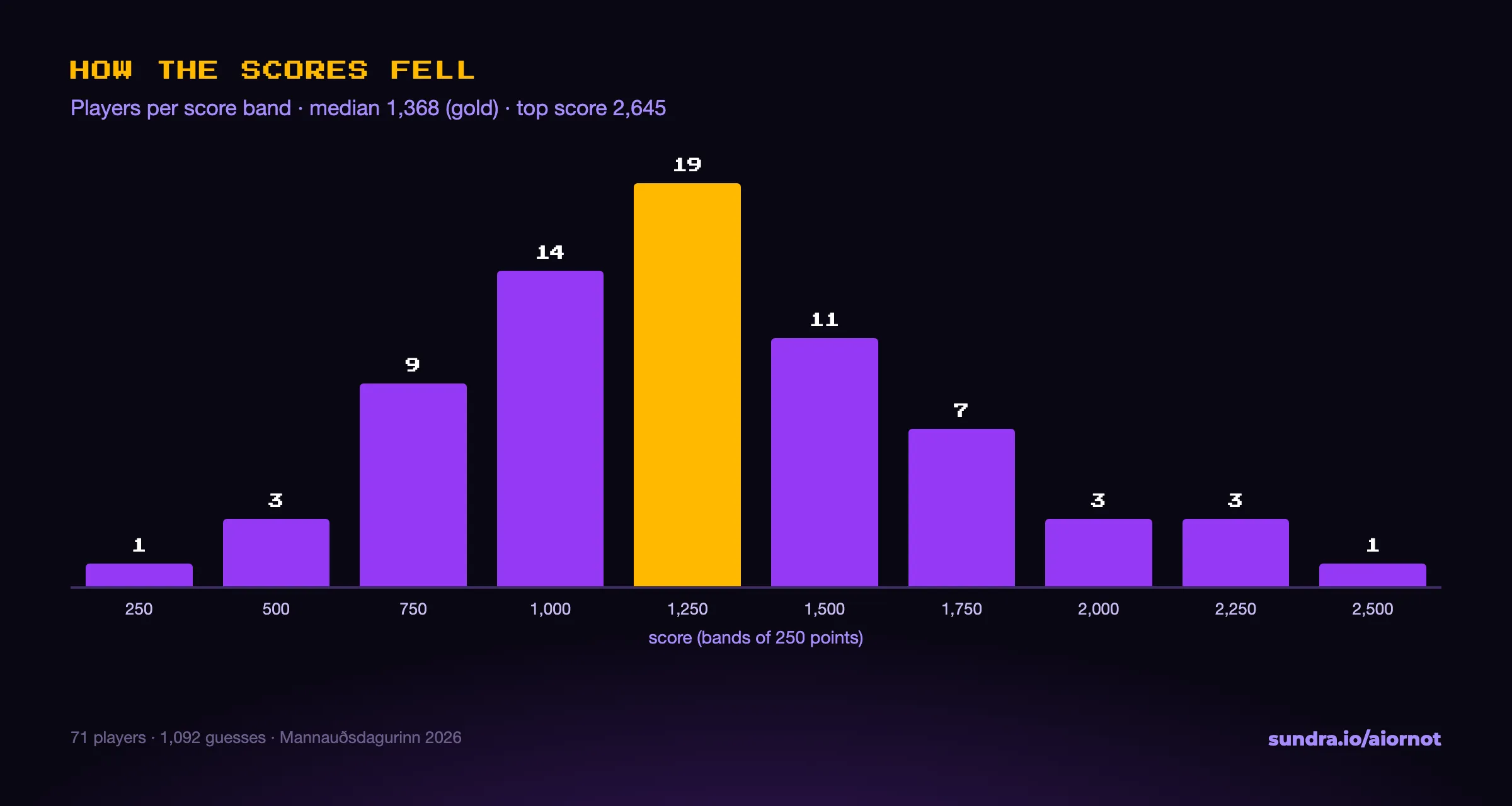
The scores form a rough bell curve that leans slightly left: most players sit a little below the middle, and a short tail of high scores pulls the average (1,393) just above the median. The streak bonus is a likely cause, since it multiplies points for every correct answer in a row, so a good run adds far more than a bad one takes away. With 71 players the lean is too small to be sure of, and no group of players stood out at the top.
What this means for HR teams
AI voices and presenters are ready for training material. More than a third of players took our AI presenters for real people, and players spotted AI voices only about half the time. For training content, that means narration and on-screen presenters no longer have to be recorded in a studio.
Icelandic is no longer a gap. Players identified only 41% of the AI-generated Icelandic voices, fewer than the English ones. Training material in Icelandic used to mean either a human recording or a robotic voice. AI voices can now produce Icelandic narration that most listeners accept as natural.
Label AI content clearly. If employees can’t tell an AI presenter from a real one, they shouldn’t have to guess. Mark AI-generated presenters and voices in your training material, so people know what they’re watching and trust the content because of what it says, not who appears to say it.
Don’t verify people by voice. The same technology can be misused. A call from “the CEO” asking for an urgent payment, or a job candidate’s video introduction, can be generated. Confirm requests like these through a second channel you already trust.
How Sundra uses AI
Sundra uses the same kinds of AI models that fooled our players, to make training material easy to create and accessible for a diverse workforce.
Most companies already have the knowledge their employees need. It sits in handbooks, safety manuals, policies and meeting notes. Sundra turns that material into complete courses:
- Course content: AI organises the source material into modules and lessons, and writes the text for each one.
- AI presenters: each lesson can be presented on video by an AI presenter, so there’s no filming, and no reshoot when a procedure changes.
- Narration and languages: courses are voiced with AI narration in more than 70 languages, so every employee can take them in their own language.
Subject matter experts review and approve every word in Sundra’s editor before a course is published. Sundra is built with responsible use of AI in mind.
Method and limitations
- Players: visitors to our booth at Mannauðsdagurinn 2026. They chose to play, so they aren’t a representative sample.
- Format: each game dealt 4 faces, 5 voices and 5 videos at random from a pool of 126 clips. Each clip had a 10-second timer, and an answer that ran out of time counted as wrong.
- Data: accuracy figures use every guess made at the booth (1,092), including a few test games played by our team. Score figures come from the 71 players who left their results with us.
- Sample sizes: each clip was seen by between 1 and 21 players, so results for individual clips are not reliable on their own. The hardest-clips table only includes clips seen by at least seven players.
- Content: at the booth, real faces came from the FFHQ research dataset (the online version now uses licensed photos) and AI faces from StyleGAN. Real voices came from LibriVox and the Talrómur Icelandic speech corpus, and AI voices from ElevenLabs. Real video came from NASA, Pexels and Creative Commons vloggers, and AI video from Google Veo 3 and ByteDance Seedance. Full credits are on the content credits page.
Play the game
AI or Not is now online at sundra.io/aiornot. It works on phones and desktops.